

Why we need imagination activism
The future won't change until we can picture it

For over a decade, I’ve made a vision board every single year.
Come January, you'll always find me head-deep in Pinterest, curating boards of the coastlines I want to swim in, outfits I want to wear, creative hobbies I want to take up, apartments I want to live in, and essentially, the dream lifestyle I’m trying to cultivate.
It’s invigorating! There’s something almost magical about seeing it all woven together like that: a clear picture of what I want, of who I’m becoming. It makes the future feel so real, so tangible. Like I could reach out and touch it.
Seeing my future laid out in front of me makes me believe I can actually get there. Like I really do have what it takes to achieve my wildest goals. And that's the whole premise of manifestation, right? What you can imagine, you can create.
So why don’t we ever apply that same logic to the world around us?
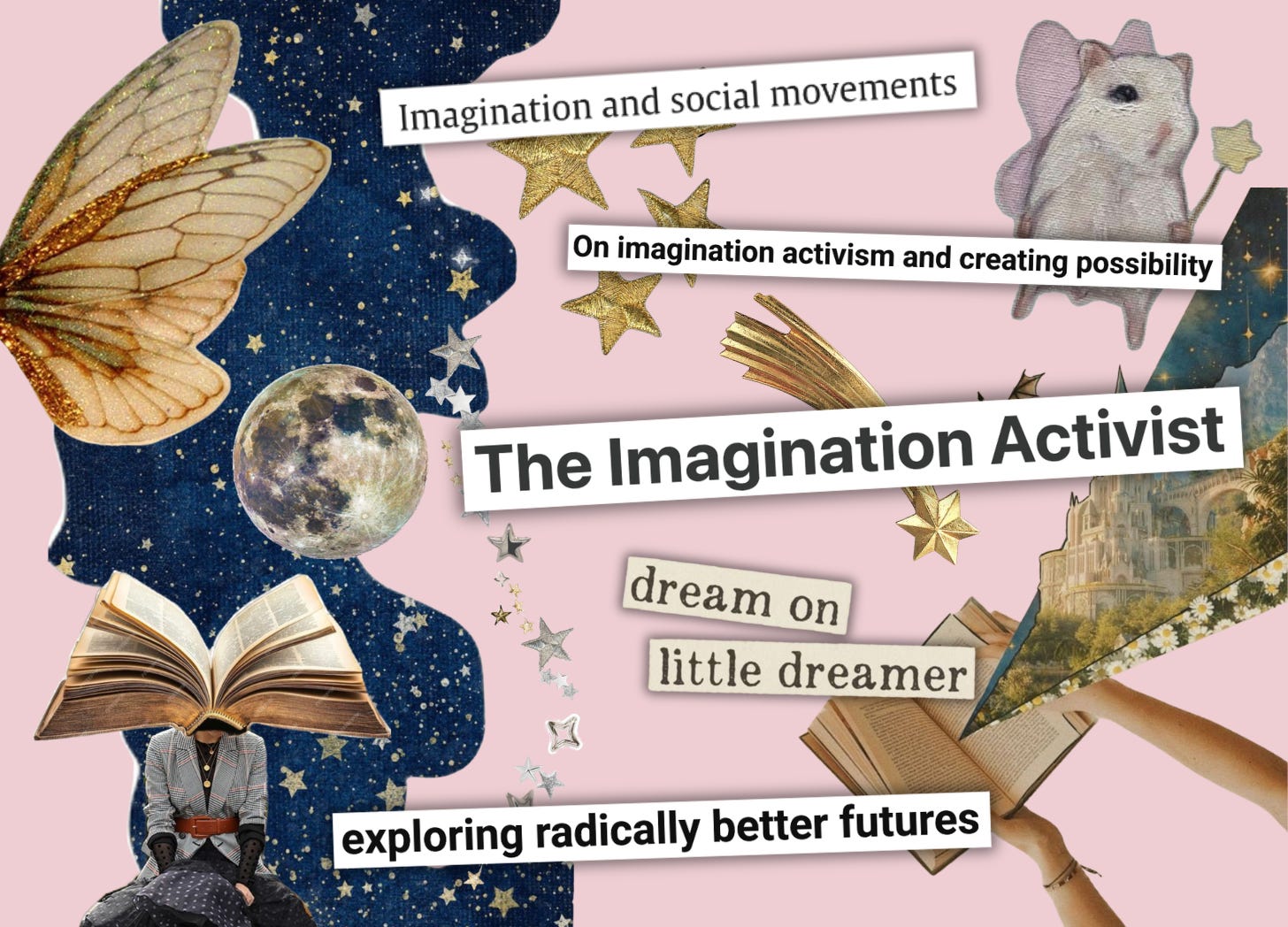
We've stopped dreaming collectively
Personal vision boards aren’t some kind of new phenomenon. They’re everywhere. We build mood boards for our careers, weddings, renovation projects, wardrobes, and our future selves.
Manifestation itself has become its own kind of economy, with journals, apps, coaches, workshops, and retreats, all devoted to picturing and pursuing the life of our dreams. Using our imagination to shape our individual lives is basically standard practice at this point.
But almost none of that imaginative energy points outward.
It’s like we’ve privatised imagination. We’ve normalised imagining better versions of ourselves, but rarely a better version of the world we share.
I mean, when was the last time you sat down and asked yourself:
What do I want the world to look like?
And I don’t mean in the vague, ambient sense (more kindness! Less inequality! Cheaper rent!). I mean with that same specificity we'd bring to our annual vision board on January 1st: what does the city street look like? The school? The economy? The hospital? The standard workday?
We spend surprisingly little time imagining what a better, more abundant society could look like – even though most of us are painfully anxious about where things are headed.
Instead, we treat the future as something that happens to us, rather than something we have any hand in imagining and designing ourselves.
This is what Imagination Activism is trying to change.
Imagination Activism
Coined by Phoebe Tickell, Imagination Activism is "a new kind of activism powered by imagination: the vision and tools to make the world better for everyone."
Much of today's mainstream activism is organised around stopping what we don't want, through protesting, petitioning, and pushing back. And while that’s still hugely important, it keeps us in a stiff, defensive posture, and never a creative one.
We have no trouble naming the crisis, or pointing to everything wrong with the world. We can picture the dystopia in vivid, cinematic detail. But when it comes time to describe the alternative – the more hopeful future – suddenly, it’s all a bit… vague.
And you can’t exactly organise people around vague ideas.
You can't invite people into a world they can't yet see.
Imagination Activism turns mainstream activism on its head – working from what's possible instead of what's wrong.
It draws on hope and imagination to sketch the specific details of a brighter future. Using that same creative muscle we flex on Pinterest, and pointing it outward toward society instead.
Essentially, it's the shift from "what do I want my life to look like in five years?"
to "What do I want the world to look like in five years?”
From “What career do I want?”
to “What kind of economy do I want?”
From “What does my dream apartment look like?”
to “What if public spaces were as beautiful as private ones?”
From “How can I be more productive?”
to “What if rest was designed into everyday life?”
From “What creative hobbies do I want to start?”
to “What if artists were considered essential workers?”
From “How can I make more friends?”
to “What would a city designed for friendship look like?”
From “What do I want to do after I graduate?”
to “What if schools were designed around curiosity and joy?”
An imagination activist is someone who keeps asking, What if?
They don’t wait to see what the future holds. They regularly train their imagination muscle to see beyond our current circumstances, to stretch their sense of what’s possible, and to inspire others to do the same.
As Tickell puts it: “The role of the Imagination Activist is to help people remember that the world could be different. It’s very simple.”
How to become an imagination activist
Before you can build a better world, you have to get specific about what it looks like first. You need to know what it feels like to live inside it.
No, you don't have to be a writer, a politician, or a fully-fledged activist to practice this. You just have to be willing to imagine.
Here's a journal prompt to get you started:
What does an ordinary day look like in a future worth living in?
If you woke up in 10-20 years from now, what's the first thing you'd notice? What can you hear from your window? How do people get to work? Where do children play after school? What has become so normal that people barely notice it anymore?
If you'd like to see an example first, Sarah Noack answers this question beautifully in her recent essay, describing her dream day in 2046:
I will wake up… on a Sunday morning in 2046 and the birds will still be chirping outside of my window.
Not because they installed speakers blasting artificial birdsong playlists to drown out the constant hum of the neighborhood data centers, but because the city itself has become a habitat again.
I open the windows of my apartment and breathe in crisp morning air that smells like a mix of wildflowers and freshly baked bread from the cooperative bakery downstairs. Children are already giggling and frolicking in the car-free streets below while their parents drink flat whites together under vibrant fruit trees we’ve planted years before.
No one spends their life rushing somewhere they don't want to be anymore. All because ten years ago… we finally decided to stop obsessively asking how cities could generate more economic growth and started working towards how they could help people live better lives. [Continue reading]
What I love most about Noak’s vision is that nothing about it is particularly dramatic. There are no flying cars or new shiny technologies. But it’s specific enough, and ordinary enough, that you can picture yourself inside it.
The importance of imagination
We’ve spent decades learning how to imagine better versions of ourselves through vision boards, manifestation and visualisation. Maybe it’s time we became just as ambitious about imagining better versions of the world around us.
Because the future won’t magically become fairer, greener or kinder on its own. Every society we’ve ever lived in was imagined before it was built, and the next one will be too.
So, ask yourself:
What do you want the world to look like?
Love this!! This was a great read that helped inject some hope and joy into the idea of activism and change, which is a nice change from the doom and gloom of modern day activism
Oh I love this 🥹 And a BIG yes to ‘you can’t invite people into a world they can’t yet see’, adding this one to my inspo note!!